Grassroots Programming
CANADA SOCCER - MANITOBA SOCCER - WINNIPEG YOUTH SOCCER - KEY TERMS - FREQUENTLY ASKED QUESTIONS - ADDITIONAL RESOURCES
CANADA SOCCER
In 2020, Canada Soccer announced its reimagined approach for youth programming in Canada and released the Grassroots Standards to be implemented nation-wide by 2026. Since that announcement, Canada Soccer has worked closely with the Technical Directors from the Provincial and Territorial Members to revise and update this document to guide clubs towards good practices in player development. By reimagining the approach, Canada Soccer aims to create an ecosystem with as many players as possible, for as long as possible, and in the best environments possible.
Canada Soccer has set out the following goals:
- “Keep more young players involved in soccer for longer by providing them with an enjoyable experience through access to high quality training and meaningful competition based on interest rather than ability.”
- “Produce clear training and competition guidelines for clubs so that they can deliver the best possible environment for young players.”
The Grassroots Standards that Canada Soccer has established are structured around a set of guiding principles for grassroots soccer in Canada. These principles are:
- Grassroots Programs should be appropriately structured for the age and stage of the participating players and allow for the opportunity for multi-sport participation, activity sampling, and life balance.
- Grassroots Matches should be played on fields, with goals and balls, and following a match day format that is developmentally appropriate for the participating players.
- Coaches have the greatest impact on the experience of players, and every child deserves a properly qualified coach.
- Children register to play soccer, not to watch others play or spend time traveling. Teams should strive for fair playing time and limit travel time as much as possible.
- Talent Identification and selection should be delayed as long as possible to provide as many players as possible with the best training environment available.
- Match results should not be the focus of grassroots soccer as this restricts player development and negatively impacts the player experience.
While Canada has some of the highest registration numbers for youth players in the world, these numbers are dropping. Even with two thirds of players being U13 or younger, attrition rates in sport are rising. Canada Soccer’s revised approach to grassroots programs in the country hopes to address the challenges that have traditionally been present within youth soccer.
Grassroots Programming is defined as all programming for youth up to U13 and this reimagined approach includes the first three stages of the Long-term Player Development model: Active Start (U4-U6), FUNdamentals (U6-U9), and Learn to Train (U10-U13).
CANADA SOCCER - MANITOBA SOCCER - WINNIPEG YOUTH SOCCER - KEY TERMS - FREQUENTLY ASKED QUESTIONS - ADDITIONAL RESOURCES
MANITOBA SOCCER
Responsible for implementing national standards, the Manitoba Soccer Association has been working closely with Canada Soccer and WYSA to serve as a platform for change and to facilitate the environment for growth within the sport. This includes community outreach, educational meetings, question and answer sessions, and constant support and engagement with its membership. The MSA provides coaching certification and training to help develop coaches and give them the tools to help prepare the next generation of players. The new Grassroots Standards implementation highlights the need for a developmental shift. Manitoba Soccer aims to change not only how we train, but also to raise the collective standard of how young players experience soccer.
In Manitoba, Grassroots Programming will be implemented using a phased approach, starting first in the 2026 Outdoor Season with the U8, U9, and U10. Those who are U11 in 2026 will remain part of the traditional league programming and will be the last group of players within that system. In 2027, U11s will be added to the Grassroots Programming framework.
Manitoba Soccer has prepared a structure for how Grassroots Centres can be established within the community through 5 key objectives: Safe Environment, Organized Set Up, Player Movement, Player Learning, and Player Enjoyment. You can read more about these objectives within the Resource Section found below.
Certification courses for coaches within each pillar of the LTPD model are also administered by the MSA. Their Technical Staff are constantly working to provide and support the community with continued education and training materials, including presentations and session plans with clear objectives designed with a players-first approach. This guidance is crucial as the implementation of the new Grassroots Programming approach to Youth Soccer is implemented and rolled out across the province.
CANADA SOCCER - MANITOBA SOCCER - WINNIPEG YOUTH SOCCER - KEY TERMS - FREQUENTLY ASKED QUESTIONS - ADDITIONAL RESOURCES
WINNIPEG YOUTH SOCCER
The Winnipeg Youth Soccer Association serves as the liaison to its Member Organizations and Manitoba Soccer. While the individual youth organizations will be responsible for facilitating internal programming, WYSA will be the link that connects them all with the larger Grassroots Programming effort around the province and the nation.
Within the province, Grassroots Programming will be implemented across 4 Programming Blocks and at 2 Programming Levels. Block 1 will occur during May and June, Block 2 will occur during August and September, Block 3 will be from Mid-October to Mid-December, and Block 4 will in February and March. During each Block, certain days of the week will be designated as Training Days and others as Match Days. Member Organizations will be responsible for running Station-Based Training and following the Grassroots Standards and the established Match Day Format. On Match Days, rosters will be established from the Open Roster System to form dynamic teams that can be adjusted and adapted to best suit the needs of the players. These Match Days Rosters will change week-to-week to aid in the development of the players and encourage growth. Players who have registered for Grassroots Level 1 and Grassroots Level 2 will still be placed within the same pool of players and will train and play together. Training Frequency is determined by the Level that a player has registered for - Grassroots Level 1 players will train once a week, while Grassroots Level 2 players will train twice a week.
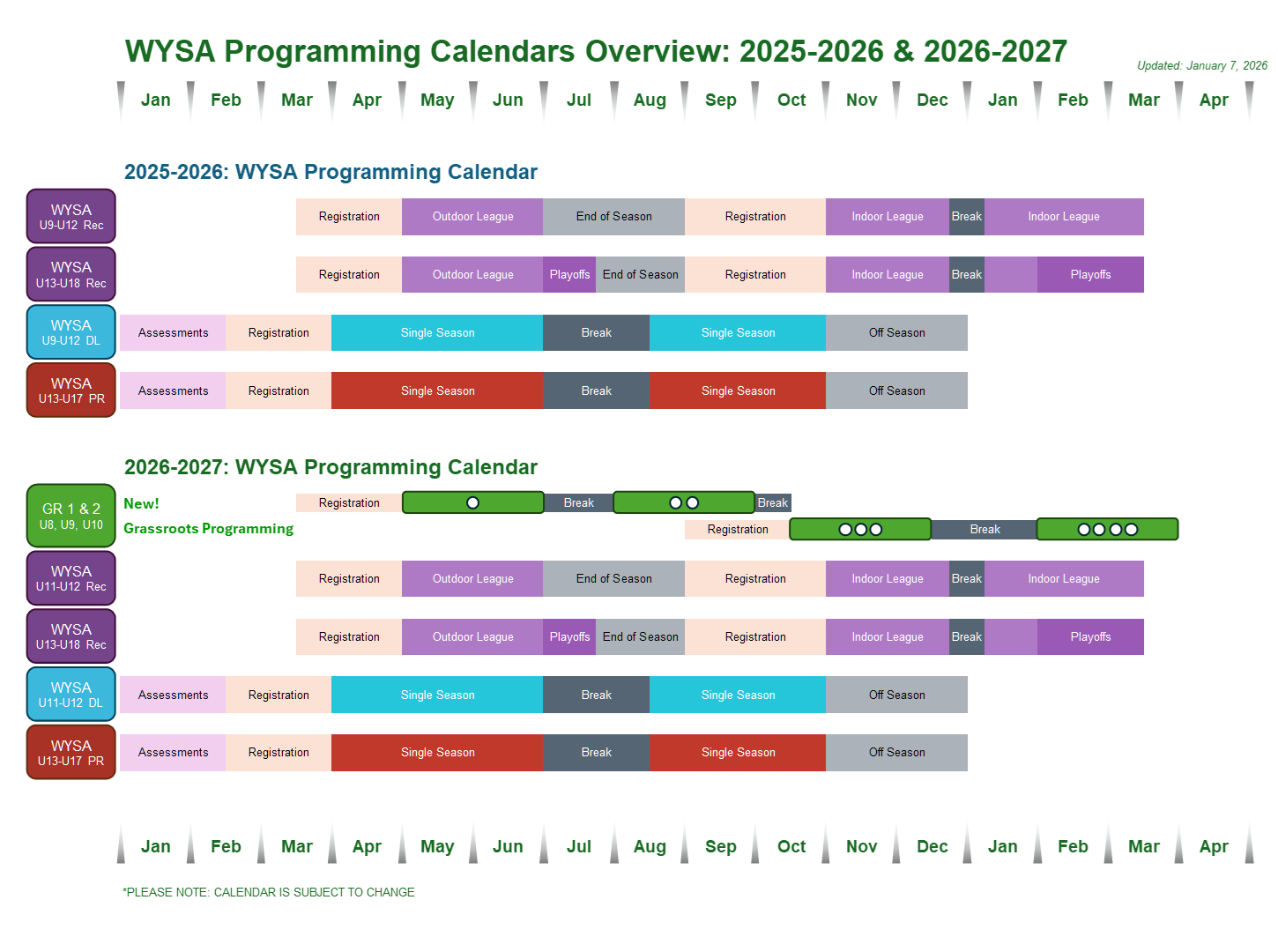
With support from the community, a Grassroots Programming Calendar has been created which outlines a full calendar year of soccer with WYSA. The calendar highlights the differences between the 2025 Season and the upcoming 2026 Season which will see the first real implementation of the new Grassroots Programming format. Two registration periods will be offered throughout the calendar year, one in the springtime for Blocks 1 and 2 during the outdoor season, and another in the fall for Blocks 3 and 4 during the indoor season. Families will be able to register for the first, the second, or for both Blocks based on the family’s preferences.
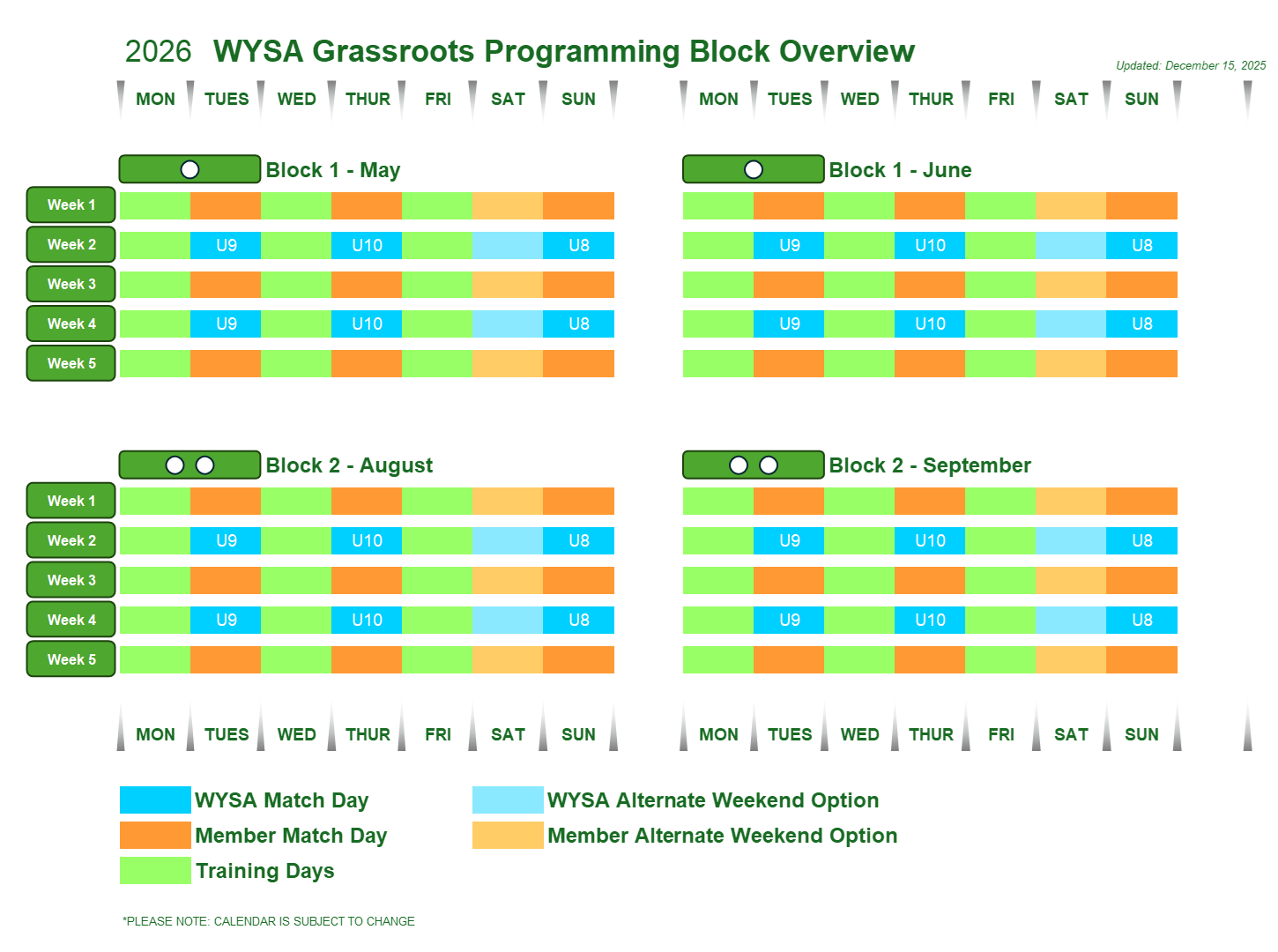
A Grassroots Programming Block Overview has also been established, which provides guidance on what a block could look like during a given season. Depending on the Member Organization hosting the program and the age of the player, a training session for a Grassroots 1 program might occur on a Wednesday, while a training session for a Grassroots 2 program might occur on Mondays and Wednesdays. These same two programs may meet again on Saturdays for the organization’s Match Day where the players will be formed into dynamic teams to play full games. Twice a month, WYSA will organize Match Days between multiple Organizations to help foster player growth and development. Additionally, WYSA will also be hosting a Jamboree once per Block in addition to the WYSA Match Days. This Jamboree will be a day dedicated to players from all Member Organizations, rather than smaller groups spread out across the city and region.
CANADA SOCCER - MANITOBA SOCCER - WINNIPEG YOUTH SOCCER - KEY TERMS - FREQUENTLY ASKED QUESTIONS - ADDITIONAL RESOURCES
KEY TERMS
Community Competitive - updated terminology for the U13 to U17 Premier stream within Manitoba.
Community Recreational - updated terminology for the U11 to U18 Recreational stream within Manitoba for the 2026 Seasons.
Developmental - referring to the playing stream for U11 to U12 Developmental divisions which is a pathway towards Community Competitive play for the 2026 Seasons.
Festival - see Match Day Format.
Game Leader - an individual such as a Coach or Technical Staff in a leadership role like a match official who facilitates a match with two teams. Game Leaders ensure that the Grassroots Standards for the Match Day Format are adhered to and that they achieve the following objectives on the field: enabling children to have a fun and rewarding experience while competing in small-sided games; ensuring player safety; and implementing simplified rules while keeping the game moving, such as limiting stoppages and assisting young players with all restarts.
Grassroots Levels 1 & 2 - Grassroots Level 1 and Level 2 are family-choice commitment levels and are not separate training groups. They determine how many times per week a child attends training, and all children train together. Grassroots Level 1 players will train once a week, while Grassroots Level 2 players will train twice a week The difference between levels is not player ability, but an organization’s operational tier and readiness - ex: staffing. An organization’s operational tier determines who can provide Grassroots Level 1 programming and who can offer Level 2 programming.
- Level 1: Leadership requires Grassroots age-appropriate training.
- Level 2: Leadership requires a C Diploma or Children’s Diploma.
An organization that does not have meet the requirements of Level 2 cannot provide Level 2 programming.
Grassroots Programming - all programming up to Under 13. This includes the first three stages of Long-Term Player Development; Active Start (U-4/U-6 M/F), FUNdamentals (U-6/U-8 F, U-6/U-10 M), & Learn to Train (U-8/U-11 F, U-9/U-12 M).
Grassroots Standards - the set of standards established by Canada Soccer which guide soccer development in Canada up to U13.
Long-Term Player Development - LTPD is a model of athlete development that parallels what doctors and psychologists have long used to better understand human development: as a series of distinct stages, which take us from infancy through adulthood. LTPD is designed to give players an optimal soccer experience at every stage by putting their needs front and center.
Jamboree - a Festival hosted by WYSA that brings all teams within a competition together where all games take place at a large venue with several additional events and amenities available for teams to experience.
Match Day Format - Grassroots programs must utilize a Festival Format for match days. “Festival Format” involves a number of teams playing their matches at a single venue rather than a match with a single home and away team as occurs in a League Format. A Match Day may include one or two matches in a day but does not include placement or elimination games. Match Days will alternate between being hosted locally by each organization and being hosted by WYSA. The Match Days hosted by WYSA will bring two or more organizations together but will not be a singular large-scale event like a Jamboree.
Match Day Roster - the match day roster is the list of players that a coach has available to play in a given match. It is important for coaches to remain within the standards provided; too few players and there is an increased risk of fatigue, burnout, and injury. Too many players and there is a risk of boredom as players will spend too much time on the sidelines and not enough time playing soccer. Canada Soccer requires “Fair Playing Time” for all players with a target of each player playing at least 50% of each match up to U13.
Match Format - The match format refers to the number of players on each team. As children are not miniature adults, it is important that they play in match formats that are appropriate for their age and stage of development. Smaller match formats for younger ages ensure players have more touches on the ball and greater development opportunities, which adds to their enjoyment of the game. This can range from very few players (1v1, 2v2 or 3v3) to the full FIFA regulation game format of 11v11.
Member Organization - an organization within the soccer landscape which is sanctioned through the governing body. WYSA’s member organizations are youth soccer clubs from Winnipeg and the surrounding region. WYSA is a member of Manitoba Soccer, who is a provincial member of Canada Soccer.
Open Roster System - an Open Roster System allows players to be moved between teams on an ongoing basis rather than the traditional approach of fixed rosters which place a group of players onto a team at the beginning of the season with limited or no opportunity for movement. In addition to exposing children to a variety of experiences, including being a leader and follower, playing with friends and having the opportunity to make new ones, amongst others, open rosters also better facilitate meaningful competition between teams, which is instrumental to player development.
Program Blocks - programs for young players are often broken up into seasons (spring, summer, fall, winter) or into multi-week “blocks.” Manitoba’s implementation of Grassroots Programming will have 2 Blocks during the Outdoor Season and 2 Blocks during the Indoor Season.
Quality Service Provider - a member organization that meets Canada Soccer’s Standards for Quality Soccer which are designed to outline the minimum expectations of member organizations in Canada. A QSP is expected to provide a developmentally appropriate, safe, enjoyable, accessible, inclusive, and welcoming environment for their participants, which differentiates it from non-member soccer and unorganized play.
Station-Based Training - a format where players rotate through small-group stations focused on specific skills. It ensures higher engagement and more touches on the ball.
CANADA SOCCER - MANITOBA SOCCER - WINNIPEG YOUTH SOCCER - KEY TERMS - FREQUENTLY ASKED QUESTIONS - ADDITIONAL RESOURCES
FREQUENTLY ASKED QUESTIONS
The Grassroots Program is a child-centered, development-focused way of delivering soccer. It ensures every young player gets quality coaching, fair playing time, and fun, meaningful experiences—helping them build skills, confidence, and a lifelong love of the game.
As the reimagined grassroots soccer model continues to be implemented in Manitoba, the following is a collection of questions that have been asked within the province by local community leaders, convenors, and staff. If you have a question that isn't answered here, please click here to reach out to us for more information!
For 2026, it should be noted that all WYSA Member Organizations are required to offer Grassroots Programming as part of their membership obligations. Accordingly, any organization that wishes to offer U11-U18 programming must also offer U8-U10 Grassroots Programming; this is a mandatory requirement with no option to opt out.
INTRODUCTION TO GRASSROOTS SOCCER
Q: What is the Grassroots Program?
A: The reimagined Grassroots Standards and Grassroots Programming is Canada Soccer’s updated, nation-wide approach to soccer for children up to U13. It focuses on creating a fun, safe, and age-appropriate environment where kids can learn, play, and stay involved in the sport for as long as possible. Canada Soccer redesigned this program to give all young players—no matter their ability—access to quality coaching, proper training, meaningful games, and positive experiences. The goal is simple: to enable more kids to play, learn, and love soccer in the best environment possible.
To support this, Canada Soccer introduced Grassroots Standards based on key principles, including:
- Programs and games should fit the child’s age and stage of development.
- Kids should get plenty of playing time and not spend long hours traveling.
- Coaches should be properly trained to support young players.
- Talent selection should happen later, so all kids have time to grow.
- The focus should be on fun and development—not on scores or standings.
Q: How does it work in Manitoba?
A: The Manitoba Soccer Association (MSA) and the Winnipeg Youth Soccer Association (WYSA) are working together to bring these national standards into local communities. This includes coach training, community outreach, and support for clubs as they adjust to the new model. Manitoba will roll out the Grassroots Program in phases starting in 2026 with U8, U9, and U10. U11 will join the program in 2027. Programs will run in four seasonal Blocks throughout the year, with set Training Days and Match Days. Clubs will use Station-Based Training and flexible, weekly match-day rosters to help players learn, grow, and enjoy the game.
Families can choose Grassroots Level 1 (one practice per week) or Grassroots Level 2 (two practices per week). All players train and play in the same pool—levels only determine training frequency.
There will be two registration periods each year (spring and fall), and WYSA will organize regular Match Days with multiple organizations and a larger Jamboree with everyone once per Block to bring players together from across the city and region.
Q: What are the new changes to grassroots soccer in Manitoba?
A: Manitoba Soccer is aligning its grassroots programming with Canada Soccer’s national standards, which emphasize inclusive, developmentally appropriate environments for players aged 8-13. Key changes include eliminating tryouts, introducing open registration, rotating training groups, and replacing leagues with festival-style events.
Q: Who does this effect?
A: All MSA member youth clubs delivering U8-U13 programming will be required to follow this model. MSA will support clubs through training, audits, and resources.
Q: Why is Manitoba Soccer changing its grassroots model? Why now?
A: These changes are not arbitrary — they are part of a national alignment initiative with Canada Soccer’s Grassroots Standards, which must be implemented by 2026. The current model has shown systemic inefficiencies in how young players are grouped, trained, and supported. The new model is designed to better serve all players, not just early bloomers or those with prior access to experienced coaching.
Q: What’s wrong with the current grassroots system?
A: While many clubs work hard, the existing model has flaws that limit player development: - Inexperienced coaches are often placed with teams of mixed-ability players without adequate mentorship or structure. - Coaches are frequently left to manage small groups (5-6 players) alone when attendance is low. - Training quality and consistency vary wildly between teams. - The current game structure still prioritizes results and fixed team identity, stifling broader development and causes friction between coaches and clubs when relationships deteriorate.
Q: How does the new model fix these issues?
A: This new training model requires each club to deliver training through a technical team. Novice coaches still participate, but in mentored roles responsible for repeating one activity throughout the session — increasing their confidence and skill while being supported by the lead staff.
Q: Why are these changes important?
A: They foster inclusive, player-first environments, remove early selection pressures, improve coaching consistency, and align Manitoba with national player development standards.
Q: Why is Grassroots a good thing?
A: Grassroots soccer is a good thing because it puts the child’s enjoyment and development at the center of the game. With age-appropriate training, fair playing time, and qualified coaches, the program creates a fun, safe, and supportive environment where kids can learn, grow, and build confidence. By focusing on skills and experiences rather than scores or standings, children can develop at their own pace without the pressure of early selection or competition. This reimagined approach also helps keep soccer family-friendly and accessible, with less travel, clearer program structure, and more meaningful opportunities for players of all backgrounds and abilities.
COMPETITION, TEAMS, AND PLAYERS
Q: What is the difference between developmental and grassroots programming now?
A: The primary goal of Grassroots Programming is to keep more young players involved in soccer for longer by providing them with an enjoyable experience through access to high quality training and meaningful competition based on interest rather than ability. Clubs are encouraged to offer programming based on training frequency. Families who wish to take part more 'recreationally' would be able to do so regardless of ability level while still receiving quality programming.
Q: Does the new grassroots program separate players based on competition levels?
A: The new grassroots approach does not differentiate between the various steams of competition. Within grassroots soccer, the training program should be considered separately from the level of competition in which a player participates. As an example, a player training three days a week may not necessarily be able to compete regularly at the highest level of competition and, alternatively, involvement in a one day a week training environment does not restrict a talented player from playing at the highest level of competition as has occurred traditionally with the separation of developmental and recreational programming. With the new approach, players are placed into player pools or training groups, rather than onto static teams. While player pools may be further divided for activities and small-sided games within a training environment, these groups are fluid and should be changed frequently to allow for a variety of learning experiences for young players.
Q: What’s the difference between Level 1 and Level 2?
A: Grassroots Level 1 and Level 2 are family-choice commitment levels and are not separate training groups. They determine how many times per week a child attends training, and all children train together. The difference between levels is not player ability, but an organization’s operational tier and readiness - ex: staffing.
Q: Who can offer Level 1 and who can offer Level 2?
A: An organization’s operational tier determines who can provide Grassroots Level 1 programming and who can offer Level 2 programming.
- Level 1: Leadership requires Grassroots age-appropriate training.
- Level 2: Leadership requires a C Diploma or Children’s Diploma.
An organization that does not have meet the requirements of Level 2 cannot provide Level 2 programming.
Q: What’s the difference between the Blocks and which ones are more/less competitive?
A: All programming blocks are considered equal opportunities for player development. Families can register for either or both of the offered Blocks for a given season (Outdoor and Indoor) and can choose Grassroots Level 2 if they would like to increase the number of training sessions they attend. Grassroots Level 1 and Level 2 players for each age group will play and develop together as part of the same player pool for a given Block.
Q: Is this just a move away from competition? Will kids still play games?
A: Players will absolutely continue to compete — the format is simply evolving. Instead of traditional weekly league play, competition will take place in the form of festival-style events. These events still feature structured games, with each team typically playing at least two matches. On alternate weekends, clubs can host internal game days or collaborate with other clubs to create local match opportunities. The competitive experience remains central — it’s just delivered in a way that emphasizes development, variety, and inclusion over standings or fixed team outcomes.
Q: How often will Match Days occur and who will coordinate them?
A: As per the Block Overview, WYSA will administer WYSA Match Days every second week following the Match Day Format. Remaining Match Days will be administered by the Member Organization.
Q: Will Community Centres be financially responsible for organizing and staffing Match Days?
A: Community Centres and other sanctioned Member Organizations may work together to host a Member Match Day, however collaborating with another organization is optional and the member may choose to host the event on their own. WYSA Match Days and the once-per-block WYSA Jamboree will also provide an additional source for players to play matches.
Q: Why remove tryouts and permanent rosters?
A: Fixed teams can create early barriers to development and bias. The new model promotes fluid grouping based on effort, engagement, and growth, not exclusionary selection.
Q: Why are there no more teams?
A: By moving away from a team-based approach and toward player pools with open rosters for competition, it facilitates more meaningful competition (fewer one-sided results), a variety of experiences for players (sometimes a stronger player on a team, other times playing alongside others who are more advanced at that moment in time), and de-couples team formation from the training program in which a player participates.
Q: What are Open Rosters?
A: An Open Roster System allows players to be moved between teams on an ongoing basis rather than the traditional approach of fixed rosters which place a group of players onto a team at the beginning of the season with limited or no opportunity for movement. In addition to exposing children to a variety of experiences, including being a leader and follower, playing with friends and having the opportunity to make new ones, amongst others, open rosters also better facilitate meaningful competition between teams, which is instrumental to player development.
Q: How will players be grouped if there are no tryouts or permanent rosters?
A: Players will be placed into fluid groupings that change week to week based on growth, engagement, and effort. This model supports player development without the pressure of fixed rankings.
Q: What will the cost be for players?
A: WYSA has established a Grassroots Per-Player Fee which will be $12.50 per player per block. The fee can be found as part of WYSA’s fee schedule, which is available on our website by clicking here.
Q: How will programming costs be utilized?
A: The Per-Player Fees will be allocated in the same general manner as WYSA’s Team Registration Fees. These funds support the overall operation of our programs, including standard administrative needs, organizational overhead, and the resources required to deliver league services and jamborees.
Q: Is this change mandatory?
A: Yes. The rollout will be phased in to allow for smooth adaptation: - Year 1: U8-U10 - Year 2: U11 - Year 3: U12-U13
Q: Is there a way for organizations to Opt-Out from the new Grassroots Programming?
A: Member Organizations will be required to participate in the Grassroots Program as an obligation of membership. There will not be an “opt-out” option for soccer providers.
TRAINING, MATCH DAY FORMAT, AND COACHES
Q: What is station-based training?
A: Station-based training is a format where players rotate through small-group stations focused on specific skills. It ensures higher engagement and more touches on the ball.
Q: What are rotating training groups?
A: Rotating groups mean players will consistently train with different teammates and coaches to ensure broad exposure, reduce bias, and support well-rounded growth.
Q: How will the year be structured for soccer programming?
A: Programming will be delivered in seasonal blocks, potentially totaling 30 weeks per year, split into three blocks of 8-12 weeks from March to January. Families can register for one, two, or all blocks.
Q: How will the Grassroots Calendar be structured to align with existing recreational programming timelines?
A: The Grassroots Calendar has been split into 4 blocks as follows:
- Block 1: May & June
- Block 2: August & September
- Block 3: Mid-October to Mid-December
- Block 4: February & March
The blocks have been created to ensure consistency with existing programming. Grassroots Level 1 & 2 may have their Match Days on the same day, rather than separated as originally indicated. WYSA will have a window of days for WYSA Match Days throughout the 2026 Season. It is important to note that Grassroots Programming could have Training and Match Days scheduled for any day of the week based on what works best for the organization. WYSA will discuss with Member Organizations in advance as to the Match Days that will be scheduled.
Q: What options are available in winter months when space is limited?
A: Clubs may offer futsal-style play, scaled-down indoor station training based on space availability, or outdoor festivals where weather permits.
Q: Why is there no more League Play?
A: League Play is no longer offered because it does not align with Canada Soccer’s model for meaningful and developmentally appropriate competition in the grassroots age groups. Traditional leagues—with fixed standings, uneven matchups, and a focus on winning—often lead to games that are either predictable or one-sided, which does not support player development.
Canada Soccer’s Grassroots Standards require clubs to create competition formats that prioritize balanced games, flexible grouping, and age-appropriate rules, field sizes, and game durations. These standards ensure that young players are matched with others of similar ability, so they stay engaged, motivated, and confident.
Starting in the 2026 playing season, all member organizations in Canada must follow these standards, which replace traditional League Play with competition formats designed to provide meaningful, development-focused experiences for all players.
Q: How do teams work on Match Days?
A: Teams are formed on Match Days with the player pool of available players for that day.
Q: What is a Festival-style Match Day and how does the Match Day Format work?
A: A Festival-style Match Day follows the required Match Day Format for grassroots programs, where multiple teams gather at a single venue to play rather than using a traditional home-and-away league format. Teams may play one or two matches, and there are no placement or elimination games. Match Days rotate throughout the season, with some hosted locally by each organization and others hosted by WYSA. When WYSA hosts, two or more organizations come together at a shared venue, creating a larger event atmosphere, but not on the scale of a WYSA Jamboree (a Jamboree is a WYSA-hosted Festival that brings all teams within a competition together with additional activities and amenities). This Festival-style approach emphasizes fun, development, and community by having divisions play in a unified, energetic environment.
Q: Are you saying the current coaches aren’t good enough?
A: Not at all. This model supports community coaches by giving them better tools, mentorship, and structure. It acknowledges that many are doing their best with limited resources — this system helps raise the floor for everyone while preserving relationships and meaningful engagement.
Q: Were grassroots coaches consulted before making these changes?
A: The structure of this model reflects years of learning not only from within our local soccer community, but also from nationwide trends, continental standards, and global best practices in youth development. While not every grassroots coach was formally surveyed, the design builds upon what many coaches in Manitoba already do well—shared sessions, skill-focused instruction, and creating fun, inclusive environments for players of all abilities. These enhancements are aligned with Canada Soccer’s national standards, which themselves draw from global leaders in grassroots programming. The model is built around methods that have consistently delivered stronger player retention, better coach support, and more positive sport experiences in countries where long-term development is prioritized over early selection. This is not a top-down imposition, but a scalable framework that continues to evolve with input from the people delivering it—local technical leads, coach developers, and mentors who work directly with players and volunteer coaches. In many ways, the new system formalizes and scales what effective coaches are already doing, providing them with the structure and support to go even further.
Q: What support will WYSA and MSA provide to help volunteers meet these expectations for 2026?
A: As the MSA is the body responsible for coach certification and education, please contact them directly.
Q: Are there any changes to coaching certifications for Grassroots Programming?
A: Manitoba Soccer is reviewing the courses to determine the best course of action that also aligns with Canada Soccer. At the end of the day, this isn’t about Recreational or Developmental, it’s just about Soccer.
Q: What minimum certification requirements will be mandated for U8-U12 recreational coaches in 2026?
A: WYSA has consulted the MSA on this subject. The MSA has confirmed that QSP members must meet these minimum standards in order to provide the following levels for Grassroots Programming.
- Grassroots Level 1 - Leaders must hold one or more of the following CSA age-appropriate Grassroots Training: Active Start, FUNdamentals, or Learn to Train.
- Grassroots Level 2 - Leaders must hold one or more of the following CSA age-appropriate Grassroots Training: Children’s Diploma or C License.
Q: Who will manage the games if referees are not used in younger age groups?
A: Games at the grassroots level (festival style) will be facilitated by Game Leaders, scheduled by the host club. One or two Game Leaders will help run each match with the active support of both team coaches. The Game Leader will look to achieve a few objectives on the field: Enable children to have a fun and rewarding experience while competing in small-sided games; Ensure player safety; Implement simplified rules while keeping the game moving — limiting stoppages and assisting the young players with all restarts. Referees will not be used for the younger age groups, as the emphasis is on development, enjoyment, and learning rather than formal officiating.
CANADA SOCCER - MANITOBA SOCCER - WINNIPEG YOUTH SOCCER - KEY TERMS - FREQUENTLY ASKED QUESTIONS - ADDITIONAL RESOURCES
ADDITIONAL RESOURCES
Canada Soccer:
- Grassroots Standards
- Canada Soccer Pathway - LTPD Community Guide
- February 13, 2026: Canada Soccer Announces Continued Evolution of Grassroots Soccer
- February 19, 2026: Applications to Host 2026 Canada Soccer Grassroots Soccer Fests Now Open
Manitoba Soccer:
- Coaching Requirements & Grassroots Pathway
- Coach Training & Certification
- Grassroots Practice Plans
- Game Leaders - Role and Responsibilities (U8 to U10)
- November 27, 2025 Update
- July 25, 2025 Update
- July 7, 2025 Update
Winnipeg Youth Soccer:
- 2026 WYSA Programming Calendars Overview (see below)
- 2026 WYSA Grassroots Programming Block Overview (see below)
- WYSA Grassroots Program Competition Information - April 16